

Table of Contents
- What Installation Support Manufacturers Actually Need
- Marine Flooring Adhesive Compatibility Guide for Production Lines
- Marine Flooring UV Resistance Standards 2026 and Installation Best Practices
- Custom Fabrication, Turnaround, and Supply Chain Support
- Durability, Maintenance, and the Long-Term Cost Picture
- Professional Installation vs. DIY Kits for Production Lines
- Frequently Asked Questions
Last Updated: September 14, 2026
What Installation Support Manufacturers Actually Need
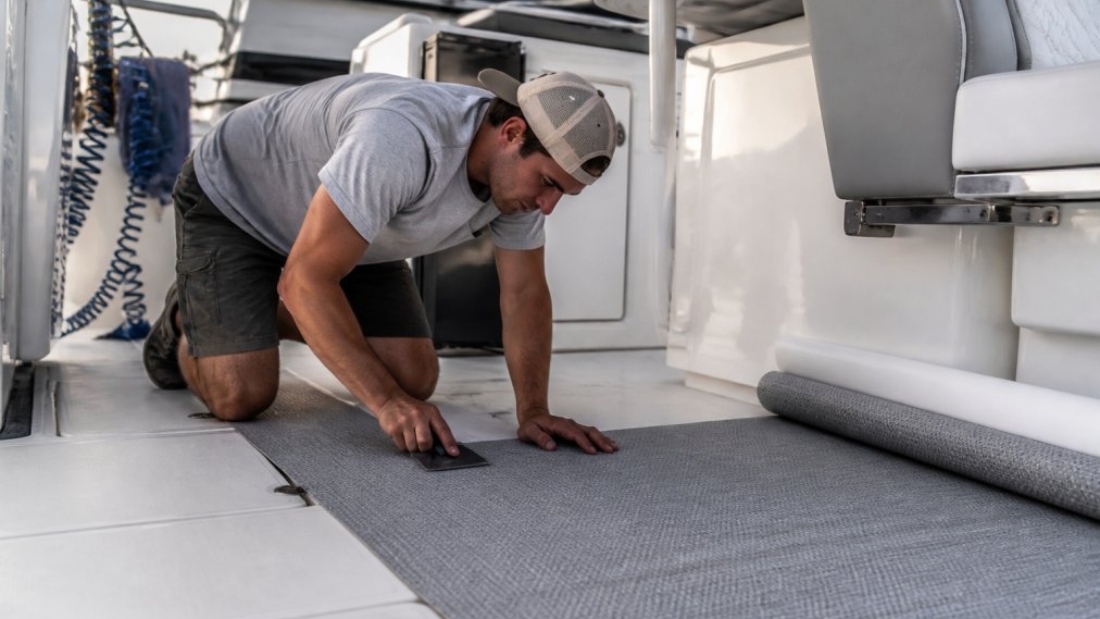
Marine flooring installation support is the technical and logistical backing a supplier provides to a boat or RV production line: material specs, adhesive guidance, cutting templates, and documentation. North River Limited brings over 15 years of specialized expertise to the marine and RV industries, offering a premium, expanded line of woven vinyl flooring directly to manufacturers. Procurement managers need a partner who understands substrate preparation, cure windows, and out-of-tolerance material.
Support falls into three categories: pre-production (template scanning, digitizing, material takeoffs), on the line (adhesive compatibility, substrate prep specs, installation tools), and post-install (maintenance protocols, warranty documentation, a point of contact).
Marine Flooring Adhesive Compatibility Guide for Production Lines
Adhesive compatibility is the most common failure point in marine flooring installation, and it’s almost always a substrate problem: vinyl lifts because the adhesive never bonded to what was underneath.
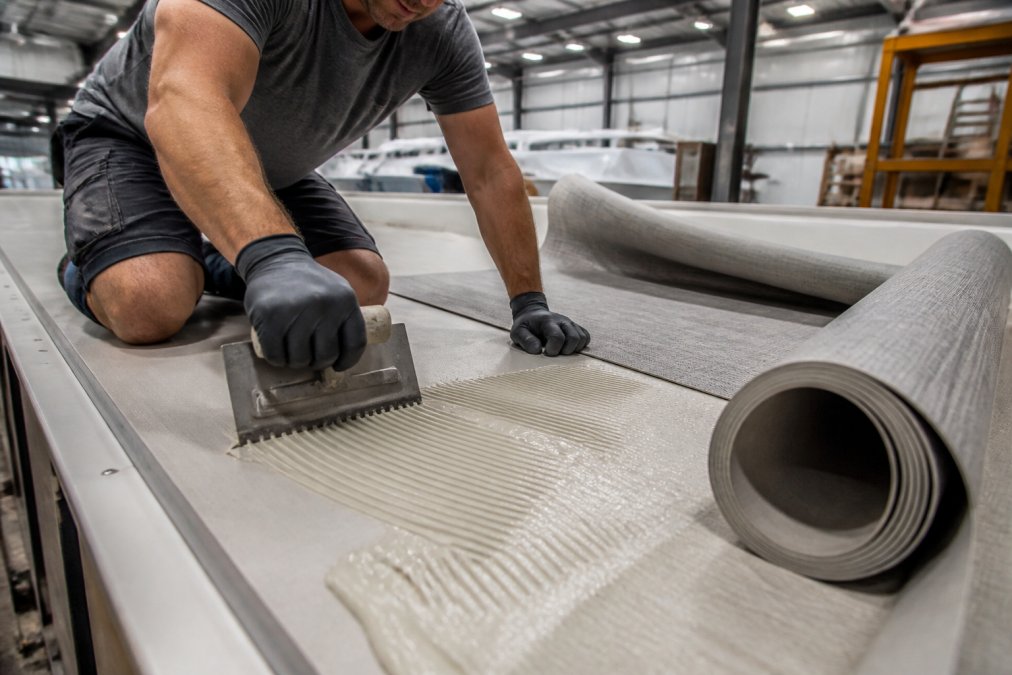
Substrates must be clean, dry, and dimensionally stable, since gelcoat, bare aluminum, plywood, and composite panels each behave differently (astm.org).
| Substrate | Preparation Priority | Adhesive Consideration |
|---|---|---|
| Gelcoat / fiberglass | Scuff and degrease | Solvent-based marine-grade adhesive |
| Bare aluminum | Etch and prime | Adhesive rated for metal bonding |
| Plywood subfloor | Seal and add moisture barrier | Flexible adhesive with movement tolerance |
Skipping substrate preparation to save line time is the most expensive shortcut in marine flooring installation. Adhesive failure typically shows up months later as bubbling or edge lift, long after the unit has shipped, and the rework cost lands on the manufacturer, not the supplier.
Marine Flooring UV Resistance Standards 2026 and Installation Best Practices
UV resistance in 2026 is a set of performance expectations manufacturers should verify against their own accelerated testing, since marine environments punish flooring with sun, salt, and temperature swings (astm.org). Ask any supplier for their UV testing methodology, not just a claim; ASTM International standards for accelerated weathering publishes the procedures most manufacturers reference.
Best practices for UV-exposed surfaces: confirm UV stabilization before specifying for open decks, allow acclimation time before cutting, use precision cutting and template scanning to minimize seams, and seal edges where UV exposure is highest.
On pontoon and deck boat lines, the edges take the worst UV beating. A small edge-seal step at install adds minutes to the build and prevents the peeling that shows up at the perimeter first.
Custom Fabrication, Turnaround, and Supply Chain Support
Custom fabrication support is where most suppliers quietly fall short, especially for smaller builders running short production runs, small batch flexibility and realistic turnaround commitments matter as much as the material. Supply chain reliability is the angle most buyers underweight until it bites them: late decking packages stall an entire assembly line, so ask about peak-season lead times, inventory buffer, and mid-run spec changes.
North River Limited supplies woven vinyl flooring directly to manufacturers, shortening the chain between production and delivery. Our Seagrass and SupremeVinyl collections are built for marine and RV environments, and we are committed to helping manufacturers reach their goals with reliable, professional-grade products.
Durability, Maintenance, and the Long-Term Cost Picture
Durability testing tells you how a material performs in a lab; real production conditions tell you how it performs after four years of sun, foot traffic, and cleaning, which is why references from other OEMs matter more than a spec sheet. Marine flooring maintenance is straightforward once installed correctly: routine cleaning with mild detergent, avoiding harsh solvents, and periodic inspection of seams and edges.
Cost factors for marine decking include material, adhesive, labor, and rework, and rework is the number that gets ignored. A slightly cheaper material that fails on a percentage of units costs more than a durable one that installs clean the first time. Pricing for woven vinyl depends on quantity, specifications, and delivery terms, so the honest answer to “what does it cost” is a quote.
Professional Installation vs. DIY Kits for Production Lines
Professional installation and DIY kits serve different buyers, and manufacturers sit firmly in the professional camp: a DIY kit makes sense for a single boat owner, not a production line running forty units a month where efficiency, consistency, and documentation drive the build schedule. The real difference is repeatability, a production team needs the same result on unit one and unit forty, with tools and templates that don’t change between runs.
For manufacturers, installation support is a production input, not a customer service perk. The supplier who provides templates, adhesive specs, and documented methods reduces line downtime and rework more than the supplier who offers the lowest unit price.
Switching flooring suppliers means new specs, training, and quality checks, the transition where most supply chain changes stall. North River Limited offers woven vinyl flooring engineered for marine and RV environments, available directly to builders. If you’re evaluating a flooring partner for your next production cycle, contact us and we’ll walk through your substrate, volumes, and turnaround requirements.
Frequently Asked Questions
What technical support should manufacturers expect from flooring suppliers?
Manufacturers should expect substrate preparation guidance, adhesive compatibility charts, cure-time specifications, and installation training for assembly teams. Suppliers should provide documented quality checkpoints and spec sheets that fit existing production workflows. For marine flooring installation support, ask for on-site or virtual training, troubleshooting guides for common failures like bubbling or lifting, and a direct technical contact who understands your line speed and volume requirements.
How does proper marine flooring installation impact long-term durability?
Correct installation determines whether flooring survives 3-4 years or fails within months. The critical factors are substrate moisture content, adhesive coverage, and adequate cure time before the vessel moves. When substrate preparation is rushed or moisture barriers are skipped, vinyl can bubble or lift, especially in high-heat environments. Following marine vinyl flooring installation best practices, including proper surface adhesion and temperature-controlled curing, directly extends product lifespan.
What are the best practices for adhesive selection in marine flooring?
Match the adhesive to your substrate, climate, and production timeline. Water-based adhesives work for controlled indoor assembly but may fail in extreme heat. Solvent-based options offer stronger bonds but need ventilation and longer cure windows. Always verify compatibility between the adhesive and the vinyl backing, test on sample panels before full production runs, and follow the manufacturer’s cure-time specifications. This marine flooring adhesive compatibility guide principle applies whether you use rolls or pre-cut decking packages.
How can manufacturers reduce labor costs during the flooring installation process?
Pre-cut, custom-fit decking packages eliminate on-site measuring and trimming, cutting installation time significantly. Template scanning and digitizing allow suppliers to deliver flooring that matches your deck geometry exactly, reducing waste and rework. Standardizing adhesive application with the right tools and training assembly teams on consistent techniques also reduces callbacks. The goal is installation efficiency: fewer steps, predictable cure times, and no surprises during final quality checks.