

Table of Contents
- Why Yacht Builders Are Switching to Woven Vinyl Flooring
- Key Benefits of Woven Vinyl for Yachts
- Woven Vinyl vs Marine Carpet: What’s the Difference?
- Marine Grade Vinyl Flooring Installation: What to Expect
- How to Clean Woven Vinyl Boat Flooring
- Addressing the Heat Problem: Thermal Management
- The Bottom Line on Long-Term Value
- Frequently Asked Questions
Last Updated: September 9, 2026
Why Yacht Builders Are Switching to Woven Vinyl Flooring
Marine manufacturers are rapidly moving away from traditional materials that fail under constant moisture and UV stress. This engineered flooring combines the softness of carpet with the resilience of vinyl, creating a surface that survives the punishing conditions of a marine environment.
Woven vinyl delivers the underfoot comfort boaters want without the mold, mildew, and odor problems that plague conventional marine carpet. Traditional carpet absorbs water and degrades quickly; woven vinyl uses synthetic fibers engineered for moisture management, allowing water to drain through rather than pool.
Key Benefits of Woven Vinyl for Yachts
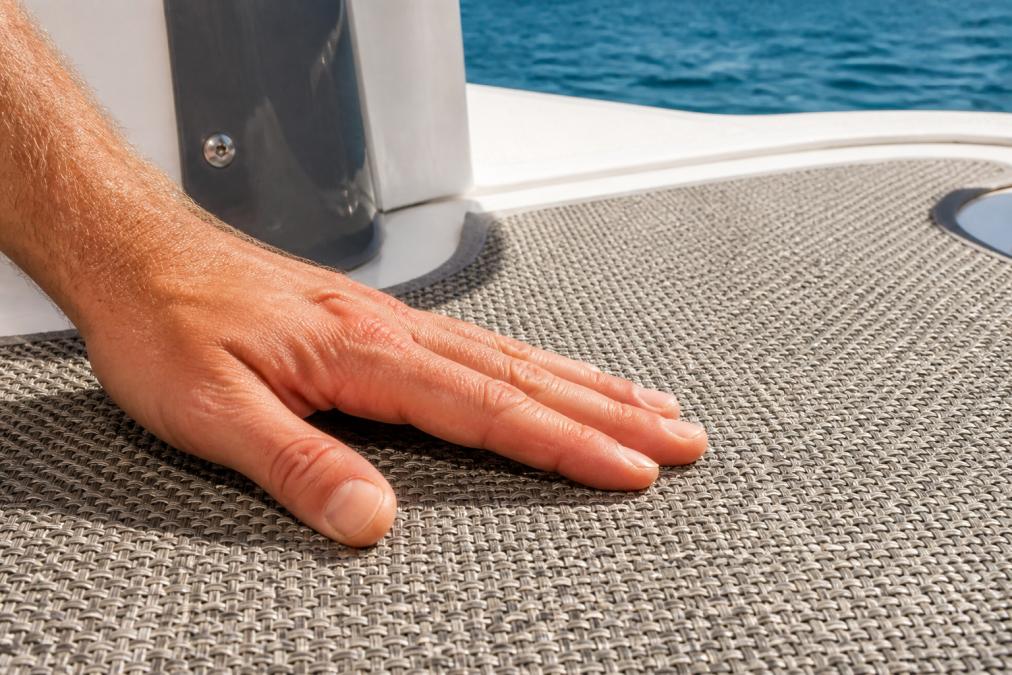
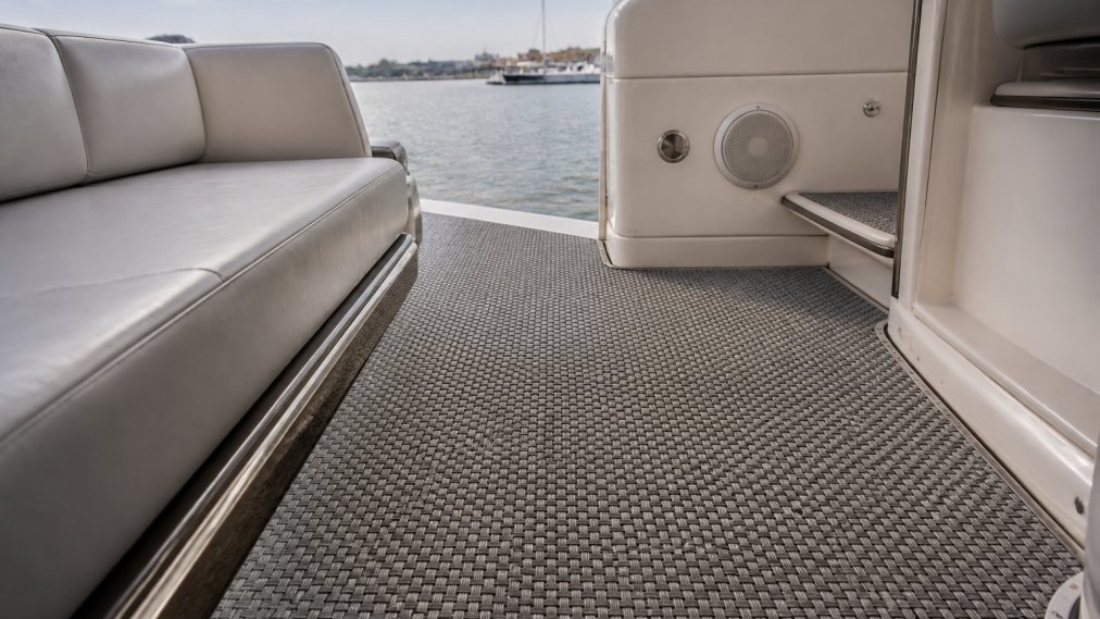
Woven vinyl is a hybrid flooring material combining a soft, textile-like surface with the waterproof and stain-resistant properties of vinyl. It is made by weaving synthetic fibers into a dense fabric backed with a waterproof layer, distinguishing it from both carpet and sheet vinyl.
Durability That Handles Constant Foot Traffic
The woven structure distributes weight and pressure more evenly than traditional vinyl, resisting indentation and wear in high-traffic areas like galleys, companionways, and helm stations. The surface is also slip resistant, even when wet, which is a critical safety feature on a pitching deck.
Built for Moisture, Mold, and UV Exposure
A common mistake is assuming all “marine grade” materials handle moisture the same way. Woven vinyl’s synthetic fibers do not absorb water, and the waterproof backing prevents moisture from seeping through to the substrate, providing genuine mold and mildew resistance. The material is also UV stable, while anti-microbial fibers inhibit the growth of bacteria and fungi.
Woven Vinyl vs Marine Carpet: What’s the Difference?
The decision that matters for a yacht owner or production manager is a lifecycle cost analysis, what does each material really cost over a decade of ownership?
The 10-Year Cost of Ownership
Marine carpet is cheaper on day one. A typical 40-foot yacht requires 400 square feet of flooring. At $8 to $15 per square foot installed, marine carpet runs $3,200 to $6,000; woven vinyl, at $15 to $25, runs $6,000 to $10,000. That premium is where most buyers stop their analysis, and where they make the more expensive decision.
Here is what the carpet buyer faces over the next decade:
- Replacement cycle: Marine carpet in a coastal environment typically needs replacement every 3 to 4 years (boatus.com). Over 10 years, that is two to three full replacements.
- Substrate damage: When carpet absorbs water and holds it against the fiberglass substrate, it accelerates osmotic blistering and core rot (westmarine.com). Repairing a soft deck core runs $5,000 to $15,000 depending on the extent.
- Labor and haul-out fees: Each carpet replacement requires pulling the boat from the water or scheduling yard time, removing hardware, and paying installation labor. At $100 to $150 per hour for marine labor, each replacement adds $1,500 to $3,000 in non-material costs.
- Cleaning equipment: Carpet owners invest in wet vacuums, extraction machines, and specialty cleaners. These purchases add up to $500 to $1,500 over the ownership period.
Woven vinyl changes the math:
- Single installation: A quality woven vinyl floor, properly installed with a snap-in system, routinely lasts 10 to 15 years in coastal service. The material does not absorb water, so the substrate stays dry and protected.
- No extraction equipment: Cleaning is a hose, a mild soap, and a soft brush.
- Removal without damage: Snap-in installation means the floor comes up in minutes for bilge access or a deep clean, and goes back down without new adhesive or replacement panels.
The Real Cost Gap
Run the numbers over 10 years for that 400-square-foot deck:
| Cost Category | Marine Carpet | Woven Vinyl |
|---|---|---|
| Initial installation | $4,600 (avg) | $8,000 (avg) |
| Replacements (2-3 cycles) | $9,200 – $13,800 | $0 |
| Substrate repair risk | $5,000 – $15,000 | $0 (waterproof backing) |
| Cleaning equipment | $500 – $1,500 | $50 (brush) |
| 10-Year Total | $19,300 – $34,900 | $8,050 |
These figures are representative ranges based on typical U.S. marine service pricing, not quotes for a specific vessel. But the pattern is consistent: woven vinyl is the lower-cost option over the realistic service life of a yacht.
The Comfort Trade-Off
The one honest advantage marine carpet retains is initial softness. Woven vinyl is firmer, closer to a dense berber carpet than a deep pile, but modern multi-layer constructions with cushioned backings now measure within 10 to 15 percent of carpet’s impact absorption. The trade-off: give up a small measure of initial plushness to gain a floor that does not stay wet, does not smell, and does not need replacement every few seasons.
When procurement teams evaluate flooring on first cost alone, carpet wins. When they evaluate on total cost of ownership, including replacements, substrate protection, and cleaning labor, woven vinyl is the clear financial choice. The 10-year cost gap is not marginal; it is typically a 2x to 4x difference in favor of woven vinyl.
For a production facility building multiple yachts per year, snap-in installation runs 30 to 50 percent faster than glue-down carpet, reducing build time and freeing crew for other tasks.
Marine Grade Vinyl Flooring Installation: What to Expect
Marine grade vinyl flooring installation surprises manufacturers accustomed to glue-down carpet. Most woven vinyl products are snap-in or loose-lay systems that require no adhesive, a significant advantage over traditional vinyl, whose glue can fail in extreme heat or with subfloor moisture, causing bubbling and lifting.
The flooring is cut to the exact template of the deck and secured at the edges with snaps or hook-and-loop fasteners, eliminating messy adhesives and allowing easy removal for cleaning or bilge access. This translates into faster installation and less downtime waiting for adhesives to cure. DIY is feasible with basic tools, but for complex decks with multiple curves, professional fitting ensures a precise finish.
How to Clean Woven Vinyl Boat Flooring
Maintaining woven vinyl is dramatically simpler than caring for marine carpet. Routine cleaning requires only fresh water and a mild soap solution; dirt rinses away because the synthetic fibers do not absorb stains. For tougher spots like fish blood, grease, or sunscreen, a soft-bristle brush with a diluted marine cleaner is typically all that is needed.
The ability to simply hose down the deck is a game-changer. Unlike carpet that requires wet vacs and harsh chemicals, woven vinyl can be cleaned quickly and dried in minutes. This ease of maintenance contributes to longevity, as grit and salt are not ground into the fibers.
Addressing the Heat Problem: Thermal Management
Heat is the number one objection to any vinyl-based marine flooring, and it is legitimate. On a 90-degree day in Florida or Texas, a dark deck surface can reach 140°F or more in direct sun. The solution is not to abandon woven vinyl but to engineer the installation and select the product with thermal behavior in mind.
How Woven Vinyl Actually Behaves in the Sun
The woven construction gives this material a genuine advantage over solid sheet vinyl or EVA foam. The fiber structure creates thousands of tiny air pockets that act as insulation, slowing heat transfer to the substrate. Solid vinyl conducts heat directly; EVA foam absorbs and retains it. Woven vinyl sits between them, cooler than solid vinyl, warmer than bare fiberglass, but without storing heat the way foam does.
Independent surface temperature tests on similar materials show the practical difference:
- Bare white fiberglass deck: 110°F
- Dark EVA foam: 145°F
- Dark solid sheet vinyl: 140°F
- Light woven vinyl: 118°F
- Medium-tone woven vinyl: 128°F
These are representative readings from marine testing environments, not a controlled scientific study. The pattern is consistent: color choice moves surface temperature by 10 to 20 degrees, and the woven structure adds another 5 to 10 degrees of mitigation over solid materials.
Color Selection Is the First Line of Defense
The single most effective heat mitigation strategy is choosing the right color. Light gray, sand, or seafoam reflects a meaningful portion of solar radiation; dark navy, charcoal, and black absorb it. The difference between light and dark in the same product line is typically 15 to 20 degrees Fahrenheit on the surface (lbl.gov).
For owners who want a dark aesthetic, the trade-off is manageable. Dark colors hide stains better and show less wear but demand more attention to ventilation and shading. A bimini top or hardtop reduces direct sun exposure significantly; for open deck areas in full sun all day, lighter colors are the practical recommendation.
Installation Strategies That Reduce Heat
Snap-in installation offers a heat management advantage glue-down systems cannot match: an air gap. When installed as a loose-lay or snap-in system over a smooth substrate, a thin air layer forms between the backing and the deck, allowing heat to dissipate and moisture to escape. Glue-down eliminates that gap, creating a more direct heat path.
For decks that sit in full sun, consider these additional measures:
- Reflective underlayment: A thin foil-faced foam underlayment beneath the woven vinyl reflects radiant heat back toward the source rather than allowing it to penetrate to the deck. This adds negligible thickness but can reduce surface temperature by 5 to 8 degrees.
- Ventilation channels: Some professional installers route shallow channels in the substrate beneath snap-in floors, allowing air to circulate and carry heat away. This is a custom solution, but it is highly effective in tropical climates.
- Shade management: The most cost-effective heat solution is a canvas bimini or shade panel. Reducing direct sun exposure by even two hours per day meaningfully lowers peak surface temperatures.
Cooling and Maintenance in Hot Climates
When a woven vinyl deck does get hot, it recovers faster than EVA foam or solid vinyl. The open weave releases heat quickly once shade arrives, and a quick rinse accelerates cooling dramatically, water evaporating pulls heat away. Charter operators in the Caribbean and Gulf Coast use this trick: a 30-second rinse before barefoot guests come on deck drops surface temperature by 15 to 20 degrees.
Avoid dark colors on fully exposed, unshaded decks in southern climates. Even with ventilation and underlayment, a dark woven vinyl surface in direct afternoon sun will be uncomfortable for bare feet. If the design requires dark tones, plan for shade coverage or accept the heat trade-off.
What to Ask Your Supplier
Not all woven vinyl products perform identically under solar load. Ask your supplier for specific data:
- What is the measured surface temperature of this product in direct sun at 90°F ambient?
- Does the backing material have reflective properties, or is it standard felt or foam?
- Is the product rated for continuous UV exposure in tropical latitudes, or only for temperate seasonal use?
- What is the recommended installation method for hot climates, snap-in or glue-down?
A supplier who cannot answer these questions is providing a commodity product, not marine-grade engineering. Manufacturers who have invested in thermal testing and can document their product’s behavior under solar load are the ones whose flooring will perform predictably off Florida, Texas, and the Gulf Coast.
Heat is a solvable engineering problem, not a reason to reject woven vinyl. Color selection alone closes most of the gap. Adding an air gap through snap-in installation, using reflective underlayment in extreme climates, and rinsing the deck before use closes the rest. The result is a floor that stays comfortable in conditions where EVA foam and solid vinyl become unusable.
For production builders, documenting these thermal management strategies in specification sheets gives your sales team a concrete answer to the most common objection, and differentiates your yachts from competitors who install dark EVA foam without a second thought about surface temperature.
The Bottom Line on Long-Term Value
When evaluating the benefits of woven vinyl for yachts, the decision increasingly comes down to lifecycle cost analysis rather than initial price. Its extended lifespan, minimal maintenance, and resistance to mold and UV damage deliver significant savings over time. Replacing soggy, faded carpet every few seasons is far more expensive than installing a durable floor once.
Because woven vinyl lasts longer and requires fewer harsh cleaning chemicals, its overall environmental footprint can be lower than that of frequently replaced carpet.
For manufacturers and boat owners looking for a flooring solution that combines durability, safety, and style, woven vinyl represents a sound investment. North River Limited offers an expanded line of woven vinyl flooring, including our Seagrass and SupremeVinyl collections, engineered to meet the rigorous demands of marine environments while providing exceptional aesthetic appeal.
Frequently Asked Questions
Is woven vinyl flooring waterproof?
Yes. The synthetic fibers and dense backing of marine-grade woven vinyl are engineered to be waterproof, not just water-resistant. This means moisture from rain, splashes, or wet gear sits on the surface and is easily wiped away, without seeping through to the subfloor. This characteristic is critical for preventing mold, mildew, and rot in the substrate, which is a primary concern for yacht builders.
How long does marine grade vinyl last?
With proper installation and routine cleaning, high-quality woven vinyl flooring typically lasts 10 to 15 years in a marine environment. Its lifespan depends on UV exposure, foot traffic, and maintenance. Choosing a marine-grade product with UV-stabilized fibers and a waterproof backing prevents the common issues of fading and delamination, ensuring the floor outlasts standard carpet or lower-grade vinyl alternatives.
Does woven vinyl flooring require special maintenance?
No, this is one of its main advantages. You do not need specialized cleaners or treatments. Routine maintenance involves sweeping or vacuuming loose dirt and washing the surface with a mild soap and water solution. For tougher stains like fish blood or grease, a soft-bristle brush with a standard marine cleaner works well. Avoiding harsh solvents and abrasive pads will keep the finish looking new.
How does woven vinyl handle heat compared to other flooring?
Woven vinyl reflects more heat than dark synthetic carpets or EVA foam, which tend to absorb and retain it. While the surface can still get warm in direct sun, it does not store heat as intensely. For decks with extreme sun exposure, pairing the vinyl with a lighter color option or a breathable backing material helps keep the surface temperature comfortable for bare feet.
Choosing the right flooring is a decision that impacts comfort, safety, and your bottom line for years to come. Whether you are retooling a production line or upgrading a single yacht, the durability and low maintenance of woven vinyl make it a compelling choice. Contact North River Limited to discuss your project requirements and see how our professional-grade flooring can work for you.