

Table of Contents
- Why RV Manufacturers Are Switching to Durable Woven Vinyl
- What Makes Marine-Grade Woven Vinyl Flooring Different
- Weight-to-Durability Ratio: The Metric Most Buyers Miss
- Comparing Woven Vinyl Options for RV Interiors
- Woven Vinyl Flooring Installation Guide for Production Lines
- Maintenance Tips for Woven Vinyl Flooring in RVs
- Repairability, Patching, and Long-Term Value
- Frequently Asked Questions
Last Updated: September 11, 2026
Why RV Manufacturers Are Switching to Durable Woven Vinyl
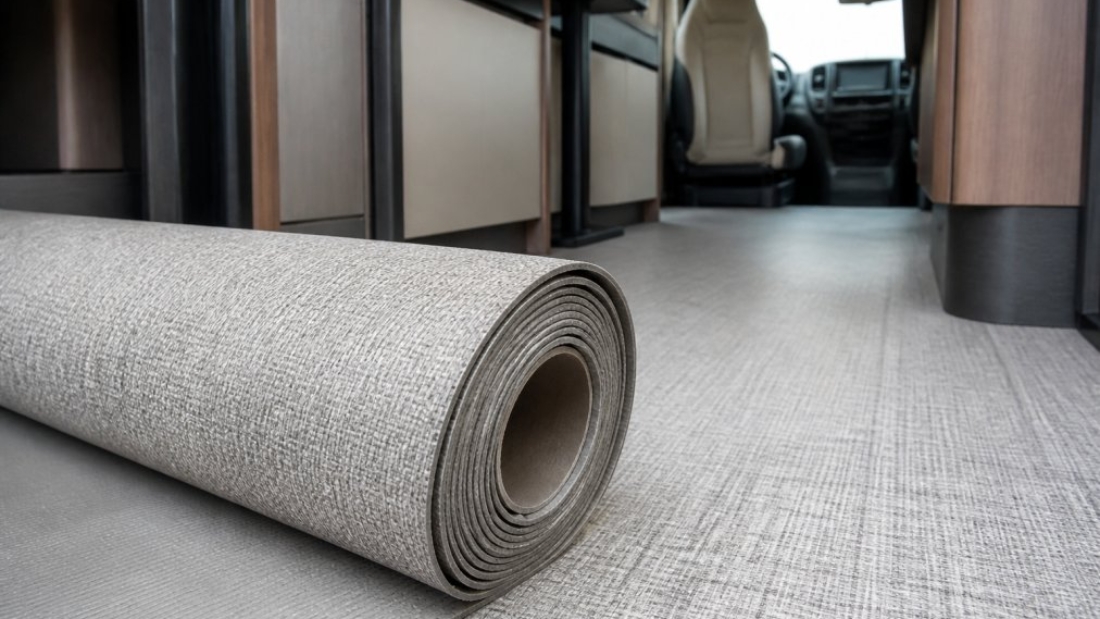
Durable woven vinyl for RV manufacturers has moved from a niche marine material to a mainstream production-line specification because it solves the two problems that plague traditional RV flooring: moisture damage and weight. North River Limited has supplied woven vinyl to boat and RV builders for over 15 years.
Structurally, woven vinyl is a resilient flooring built from synthetic fibers fused into a marine-grade backing, giving it dimensional stability under temperature swings that would buckle cheaper floor covering options.
Woven vinyl wins in RVs because it combines the durability rating of commercial-grade flooring with a weight profile that laminate and ceramic tile cannot match. That combination is what production engineers actually care about.
What Makes Marine-Grade Woven Vinyl Flooring Different
Marine-grade woven vinyl flooring is made by weaving vinyl strands into a fabric-like sheet, then bonding that sheet to a backing engineered for moisture, UV, and abrasion exposure, formulated for constant humidity, salt air, and direct sun.
Core Construction and Backing Options
Two backing systems dominate RV production: TPO backing and cushion backing. TPO is a thermoplastic polyolefin layer that provides moisture resistance and mold and mildew resistance without adding much mass. Cushion backing adds a foam or felt layer that improves impact resistance and underfoot comfort where the subfloor is thin plywood. Towables stored outside year-round benefit more from TPO; high-traffic motorhomes lean toward cushion backing for abrasion resistance and comfort.
UV Stabilization and Fade Resistance
UV stabilized woven vinyl resists color shift because pigment is locked into the vinyl strand during extrusion rather than applied as a surface coating, the difference between a fade-resistant floor and one that looks sun-bleached after two seasons, which directly affects warranty exposure.
Weight-to-Durability Ratio: The Metric Most Buyers Miss
Most flooring spec sheets list tensile strength and abrasion resistance separately, which tells a procurement manager little about the real trade-off. The metric that predicts RV performance is weight per square foot relative to durability rating. Woven vinyl delivers commercial-grade wear at a fraction of the weight of tile or engineered hardwood; across a fleet of 40 units a month, that difference feeds into fuel economy and towing capacity.
Here is how the common RV flooring categories compare on the factors that matter to production teams:
| Flooring Type | Relative Weight | Moisture Resistance | Typical Best Use |
|---|---|---|---|
| Woven vinyl | Low | High | High-traffic RV interiors |
| Sheet vinyl | Low | Moderate | Budget towables |
| Laminate | Medium | Low | Dry-climate units |
| Ceramic tile | High | High | High-end motorhomes |
The takeaway: if high-traffic durability is the priority and weight is constrained, woven vinyl is the only category that satisfies both.
Comparing Woven Vinyl Options for RV Interiors
Woven vinyl products differ mainly in backing, weave density, and surface treatment. A denser weave correlates with better soil resistance and cleanability; a looser weave feels softer but traps debris. North River Limited’s Seagrass and SupremeVinyl collections were developed for marine and RV applications, engineered around stain-resistant surface behavior, anti-microbial treatment, and thermal stability.
Thermal Insulation and Cushion Backing Benefits
Cushion backing does more than comfort: air trapped in the foam acts as a thermal break between subfloor and cabin, reducing heat transfer both ways, a cooler floor in summer, a less frigid surface in winter, a real consideration for four-season RVs.
VOC Emissions and Indoor Air Quality
VOC emissions are the specification most RV manufacturers still underweight. Enclosed cabins concentrate whatever the flooring offgasses, and buyers increasingly ask about indoor air quality. Woven vinyl is generally lower-VOC than adhesives-heavy installations, but the adhesive matters as much as the floor.
Woven Vinyl Flooring Installation Guide for Production Lines
This woven vinyl flooring installation guide covers the production-line sequence, not a DIY job, assuming a plywood or composite floor substrate and a shop running multiple units per shift.
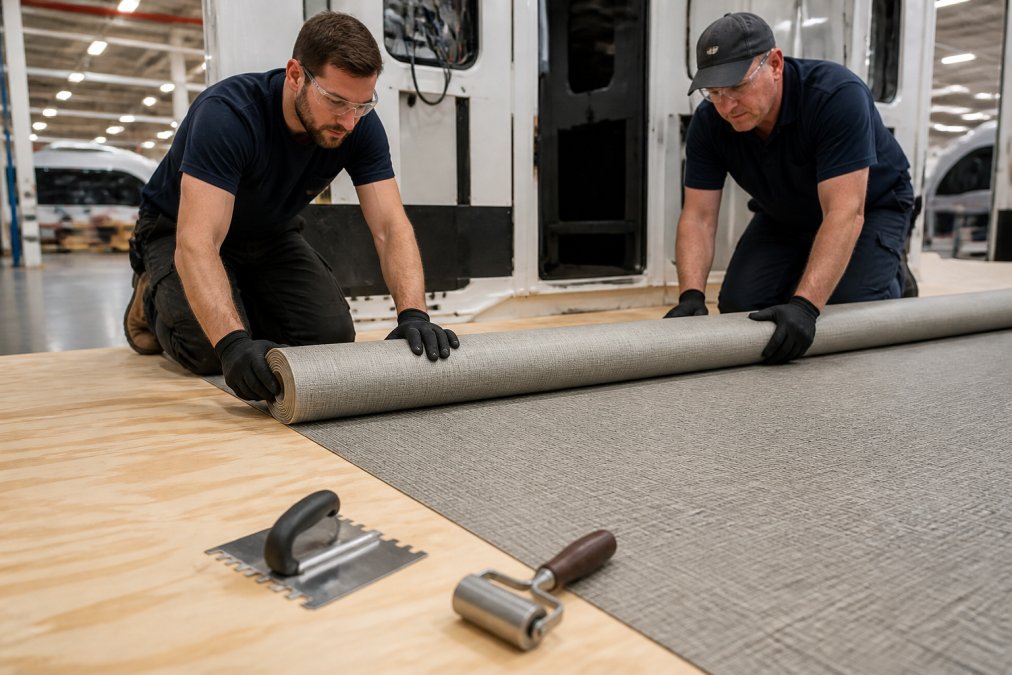
- Verify the subfloor is clean, dry, and flat within tolerance
- Acclimate the flooring rolls to the shop temperature before cutting
- Dry-fit the layout and mark seams before any adhesive is applied
- Apply the specified installation adhesive with the correct trowel notch
- Roll the flooring into the adhesive and work out trapped air
- Weld or seal seams to prevent moisture ingress
- Roll the finished floor and allow the adhesive to cure fully
Subfloor Prep and Adhesive Selection
Adhesive failure is the most common complaint from RV production teams, and it almost always traces back to subfloor prep or the wrong adhesive chemistry. The installation adhesive must be rated for the temperature range the vehicle will actually see. A product specified for a climate-controlled shop can fail in a unit parked in full sun.
Three variables drive most failures:
- Subfloor moisture content. Plywood above roughly 12% moisture content on a pin meter traps vapor under the flooring and pushes the adhesive into premature release (apawood.org). Check composite substrates against the flooring supplier’s written tolerance, not a generic rule of thumb.
- Surface flatness. A common production tolerance is no more than 1/8 inch deviation across a 10-foot span (nwfa.org). High spots telegraph through a woven sheet; low spots become air pockets that flex and delaminate.
- Adhesive open time vs. line speed. A fast-curing adhesive that skins over before the roll is laid produces a mechanical bond instead of a chemical one. Match open time to how long your crew actually takes between troweling and rolling.
Skipping seam welding to save cycle time is the single most common cause of later moisture problems. An unsealed seam lets water reach the substrate, and once the plywood swells, the floor has to come up.
Seam Welding, Acclimation, and Cycle-Time Trade-offs
Seam welding is where production-line installation diverges most from residential work. Heat-welded seams create a continuous membrane that resists moisture ingress at the joint, which matters in an RV because the floor sees condensation, tracked-in water, and occasional plumbing leaks. Cold-seam adhesives are faster but rely on the same adhesive chemistry already under load, so they offer less margin.
Acclimation is the step crews most often skip under schedule pressure. Rolls that go from a cold warehouse onto a warm shop floor expand as they warm, and a floor cut to fit at 50°F can buckle at 90°F in a parked unit. Most manufacturers specify a minimum acclimation window, commonly 24 to 48 hours at ambient shop temperature, which should be built into the production schedule, not treated as optional.
Cycle time is the real constraint. A two-person crew can typically lay, roll, and weld a single RV floor in a few hours once the substrate is ready, but the adhesive cure window before foot traffic is the bottleneck. Sequencing flooring early in the build, before cabinetry and fixtures, lets the cure happen while other trades work.
Production-Line Quality Checks
A short inspection routine catches most installation defects before the unit ships:
- Bond check. Walk the floor and listen for hollow spots; a dull thud instead of a solid tap signals an unbonded area.
- Seam inspection. Run a fingernail along each weld; a seam that lifts at the edge will fail under traffic.
- Edge termination. Confirm the flooring is secured at thresholds, slide-outs, and step wells, where flexing concentrates stress.
- Temperature log. Record shop temperature and substrate moisture at install; this documentation is what defends a warranty claim later.
Adhesive and substrate moisture guidance for resilient flooring
Repairability and Patching After Installation
Woven vinyl is one of the few resilient flooring types that can be patched without replacing an entire room: a damaged section can be cut out and a matching piece inset, provided the manufacturer keeps dye lots consistent and supplies patch material.
For production teams, patch material should be ordered alongside the original run. Dye lots shift between batches, and a patch cut from a later lot can read as a visible square even when the pattern matches. Keeping a small reserve of the same lot on hand turns a potential full-floor replacement into a 30-minute repair.
Long-Term Value and Total Cost of Ownership
Long-term value in an RV context is not just purchase cost. It is the cost of the floor over the life of the vehicle, factoring in replacement cycles, downtime, and warranty claims. A floor that lasts twice as long and can be spot-repaired cuts total cost of ownership even at a higher unit price.
Maintenance Tips for Woven Vinyl Flooring in RVs
Maintenance tips for woven vinyl flooring come down to three habits: regular dry removal of grit, prompt cleanup of spills, and periodic deep cleaning with a manufacturer-approved cleaner. Grit is the enemy of abrasion resistance, because it acts like sandpaper underfoot.
- Sweep or vacuum high-traffic zones weekly during the season
- Blot spills immediately rather than wiping them across the surface
- Use a pH-neutral cleaner; harsh solvents can dull the surface treatment
- Avoid steam cleaners, which can stress the adhesive at seams
- Inspect seams and edges at the start of each season
Why Maintenance Is a Warranty-Cost Decision, Not a Cleaning Decision
Most maintenance content stops at the cleaning list. For a manufacturer, the more useful frame is warranty exposure: flooring claims cluster around a few failure modes, most tracing back to owner-controlled maintenance behavior, meaning claim rates can be influenced through documentation and dealer training rather than product changes. The biggest claim generators are consistent:
- Seam separation from prolonged moisture exposure at the joint
- Edge lifting at slide-outs and step wells where flexing concentrates stress
- Surface dulling from abrasive or solvent-based cleaners that strip the surface treatment
- Staining from spills left to sit, particularly oils, red wine, and rust-tracked water
- Delamination from substrate moisture that was never addressed at install
Each of these is cheaper to prevent than to remediate. A seam that separates early can be re-welded; a seam that separates after the substrate has swelled requires floor removal.
Dealer-Network Protocols That Reduce Claims
Establishing clear maintenance protocols at the factory level and passing them to the dealer network reduces warranty claims more than any single product upgrade. The lowest-claim manufacturers do three things:
- Ship a written care guide with every unit. A one-page document covering approved cleaners, prohibited products, and inspection intervals gives the owner a defensible standard and gives the manufacturer a reference point if a claim is disputed.
- Train dealer service writers on the failure modes. A service writer who recognizes early seam separation can schedule a re-weld before the substrate is affected.
- Stock patch material at the dealer level. A dealer who can patch a burn or tear in a day avoids the cost and downtime of a full-floor replacement.
A common pattern among low-claim manufacturers is to bundle the care guide with the unit’s owner manual rather than handing it over separately. Documents that live with the vehicle get read; loose inserts get lost.
Cleaning Products and What to Avoid
The cleaning list above is the baseline, but the specifics matter more:
- Approved: pH-neutral cleaners, warm water, soft-bristle brushes, microfiber mops
- Use with caution: mild dish soap in dilute solution, only when a neutral cleaner is unavailable
- Avoid: steam cleaners, abrasive pads, bleach-based products, solvent-based degreasers, and any cleaner containing citrus oil in high concentration
Steam cleaners deserve a specific warning: the heat and moisture combination can soften adhesive at seams and edges, and the damage often does not show up until the unit has been through a few temperature cycles. Solvent-based degreasers strip the surface treatment that provides stain resistance, leaving the floor vulnerable to the next spill.
Seasonal and Storage Maintenance
RVs sit unused for long stretches, and storage conditions drive a disproportionate share of flooring problems. A unit stored with slides in and no ventilation can trap humidity against the floor for months; manufacturers who advise owners to leave a vent cracked and run a desiccant pack see fewer moisture-related claims.
At the start of each season, a short inspection catches most developing issues:
- Check seams and edges for lifting or separation
- Look for discoloration that could indicate moisture under the flooring
- Confirm slide-out tracks are clear of grit that could scratch the floor during operation
- Re-verify that thresholds and step wells are still properly terminated
Repairability as a Maintenance Strategy
The maintenance conversation and the repairability conversation are the same conversation. A floor that can be spot-repaired changes the economics of every failure mode above: a burn, a tear, or a localized stain becomes a patch job instead of a replacement. That is why patch material availability and dye-lot consistency belong in the maintenance plan, not just the installation spec. North River Limited supplies woven vinyl directly to manufacturers, giving production teams a single point of contact for spec sheets, patch material, and technical documentation.
Repairability, Patching, and Long-Term Value
RV flooring decisions get expensive when they are made on unit price alone. The manufacturers who get it right treat flooring as a durability and weight problem, not a cosmetic one, and partner with a supplier who understands both. North River Limited brings over 15 years of specialized expertise to marine and RV flooring, with an expanded line of woven vinyl available directly to manufacturers. Our Seagrass and SupremeVinyl collections are engineered for marine-grade, UV stabilized, anti-microbial performance at a more affordable price point than legacy suppliers. Contact North River Limited to request spec sheets, patch material samples, and volume pricing for your production line.
Frequently Asked Questions
Is woven vinyl waterproof enough for RV subfloors?
Woven vinyl itself is moisture-resistant and won’t absorb water, but waterproofing depends on the full assembly. Seams must be welded or sealed, and adhesive coverage must be complete. If a seam fails, water can reach the substrate. For RV manufacturers, specifying seam welding and moisture-resistant adhesive is the practical safeguard. North River Limited’s SupremeVinyl is engineered for marine and RV environments where moisture exposure is constant.
How does woven vinyl compare to traditional RV carpet for longevity?
Woven vinyl outlasts carpet in RVs by a wide margin. Carpet traps dirt, holds moisture, and stains permanently, especially in high-traffic entryways and galley areas. Woven vinyl resists stains, cleans with a damp mop, and won’t harbor mold or mildew. For manufacturers, the switch reduces warranty claims tied to carpet degradation and eliminates the cost of carpet replacement in refurbished units.
What installation standards should manufacturers follow for woven vinyl?
Key standards include a clean, dry, flat floor substrate, full-spread adhesive applied with the correct trowel notch, and seam welding or sealing for moisture protection. Acclimation to the production environment before installation prevents dimensional shifts. Manufacturers should also verify adhesive compatibility with the specific backing type, whether TPO, cushion, or standard. Following these steps reduces bubbling, lifting, and callbacks.
Does UV stability affect how long RV flooring lasts?
Yes. UV exposure breaks down lower-quality flooring, causing fading, brittleness, and surface cracking. UV-stabilized woven vinyl maintains color and structural integrity under prolonged sun exposure, which matters for RVs stored outdoors or used in southern climates. Manufacturers should ask suppliers for UV stabilization documentation and compare fade resistance against the expected service life of the vehicle.